Redemption and Renewal
Looking back on the last 11 years of living with complex regional pain syndrome (CRPS), I have been afforded a unique perspective on the concepts of agony and ecstasy. The agony of grieving a future I would never attain and the ecstasy of realizing the future I was always meant for.
I moved to Los Angeles in 2013 with the goal of working in film and television. As a child, I was passionate about movies, books, and TV. In the second grade, I wrote my version of the film Aliens, featuring my rural Catholic elementary school (to the mortification of my parents, who had to reassure the nuns I wasn’t insane). I was seven when I wrote it, and I still remember the color crayons I used to depict xenomorphs invading our cafeteria. Sigourney Weaver’s character “Ripley,” the hero of the movie, I drew on top of our lunchroom table, blasting away at face-huggers with a gun.
This core memory informed my future goals and aspirations. I wanted to work in Hollywood. I wanted to be in the room where the writing and creativity happened. I wanted to be a part of the magic of make-believe on screen. But where I lived (northern Indiana) did not have a thriving film industry. After graduating from college, I enrolled in the Entertainment Industry Management program at Carnegie Mellon University. The program offered me everything I needed to enter the industry: opportunities to intern with film and TV production companies, to learn the business side of movies and television, and to learn how to write and make a movie.
When I graduated in 2014, I secured a job as an office manager at Snoot Entertainment, a film production company in Venice Beach. I helped with screenplays, film marketing, and more. My life was on the track I had so desperately wanted since I was a little girl. I was 26 years old and ready to take on the world. But less than eight months later, those dreams and goals shattered.
On paper, I did everything right. I had a fantastic job with great benefits, and I decided to put them to use. I was a college rugby player and had been injured for the last few years. I did not have health insurance when it first happened, so I waited until I had medical benefits to get checked out. An arthrogram confirmed my worst fear: I had torn the cartilage in my right hip, resulting in bone erosion.
From a young age, sports and exercise became one of my greatest outlets for stress and anxiety. If I was feeling worn down by school or family, a four-mile run would ease my stress quite nicely. Feeling stressed about an upcoming test or assignment? An afternoon of basketball would ease my worries. Exercise and sports were a lifeline for my fragile teenage self, and I was fragile – at least physically. I was prone to injuries like sprained ankles and other ligament problems with painful recoveries.
Pain is an athlete’s constant companion. It is the monkey on your back, clawing at your sanity and reminding you that you’re not invincible. Sometimes pain is as mild as a blister on your toes; other times it’s a broken bone or a concussion. There are many preventive measures to reduce the risk of injury in sports and keep it from becoming too severe. But as humans, we cannot prevent everything. Sports and athletics involve injuries.
Pain is the body’s way of warning us that something is wrong; an alarm system meant to signal our conscious minds to get help or treatment. But what if your alarm system was triggered 24/7? What if your body believed it was mortally damaged to the point where your pain signals never stopped? Even worse, what if this agony was completely invisible? How does anyone cope or live their life to the fullest in agony?
Real-life alarms can be turned off and reset. We have technicians who can come out and fix the problem and troubleshoot why our warning systems are malfunctioning. But for the human body? We haven’t figured that out yet.
I wouldn’t realize this until after I had surgery to repair my hip. My hip surgery was meant to be a routine procedure and recovery. Technically, my surgeon did nothing wrong. The surgery was a success. But something went wrong in my body. Weeks after I had my hip repaired, I began having what felt like lightning strikes in my right hip and leg. It felt as if my leg had been dipped in pressurized salt acid or as if someone had sprayed napalm into my limb. I struggled to sit comfortably, and I couldn’t work in my office. I was, for all intents and purposes, fully incapacitated.
It would be six months before I was diagnosed with complex regional pain syndrome. Six months of living with fear and terror, of seeing specialists and doctors who would shrug their shoulders at my plight and give noncommittal responses such as “Have you tried yoga or acupuncture?” I frequented the offices of neurologists, rheumatologists, orthopedic surgeons, general practitioners, psychiatrists, therapists, and even geneticists. I went to the ER multiple times due to excruciating pain. I lost 30 pounds because I was vomiting from the pain. No one had any answers for me, and this realization was the most devastating of all.
I couldn’t sit in a chair, which meant I couldn’t drive my car or go to my office. I was extremely lucky that my bosses let me work from home, and this was before the COVID-19 pandemic. They were so generous, kind, and understanding – and let me work from home for several years. I don’t know any other company or workplace that would do this. To this day, I attribute my recovery to the people at Snoot Entertainment. Without their generosity, I wouldn’t be here. My health insurance and their support allowed me to rest and seek answers, to figure out what was wrong with my hip.
We live in an unprecedented era of access to information. Each of us has a phone capable of researching any topic on earth. We can all watch videos or lectures on any subject, featuring speakers from all over the world. Yet how can we live in the age of technological and scientific enlightenment and have no idea what causes CRPS? We can split an atom and put a man on the moon, but we can’t determine the cause of my pain?
At the time, I felt as if my life was in shambles. I couldn’t exercise or move without pain, so the methods I had developed over the last 15 years, such as exercising to relieve stress, were unavailable to me. I couldn’t run off my stress or worries. I had lost the ability to run or exercise strenuously; it felt as if a piece of my soul had been excised. I needed to find a way to cope with my grief.
In my opinion, grief is the fulcrum of love. It is the price we pay for love and affection – the result of caring so deeply we feel gutted when it is gone. After I was diagnosed, after I realized that I might not ever work again, I became inconsolable with grief. I had to let go of the life I thought I would have and embrace the life I was currently living. I had to find a way to live and to accept my reality. But this was easier said than done.
For the next five years, I worked from home and focused on healing. I became an advocate for chronic pain patients, lending my voice and experiences to the website, National Pain Report. I attended conferences and events catered towards understanding pain. Slowly, I started to find ways to deal with my pain. I turned to writing, drawing, painting, and reading books. Books to this day have never let me down.
The same is true for movies. Movies gave me an opportunity to distract myself from the pain and cope with my diagnosis. During the COVID-19 pandemic, I connected with a director and writer named Matthew Ross. He listened to my story of how I came to be in LA and how I developed CRPS. He was so inspired by my journey that he included a character with CRPS in his award-winning film Invisible. The movie examines grief, loss, addiction, and love. The character based on me helps the protagonist heal, and she is an advocate for those who are suffering.
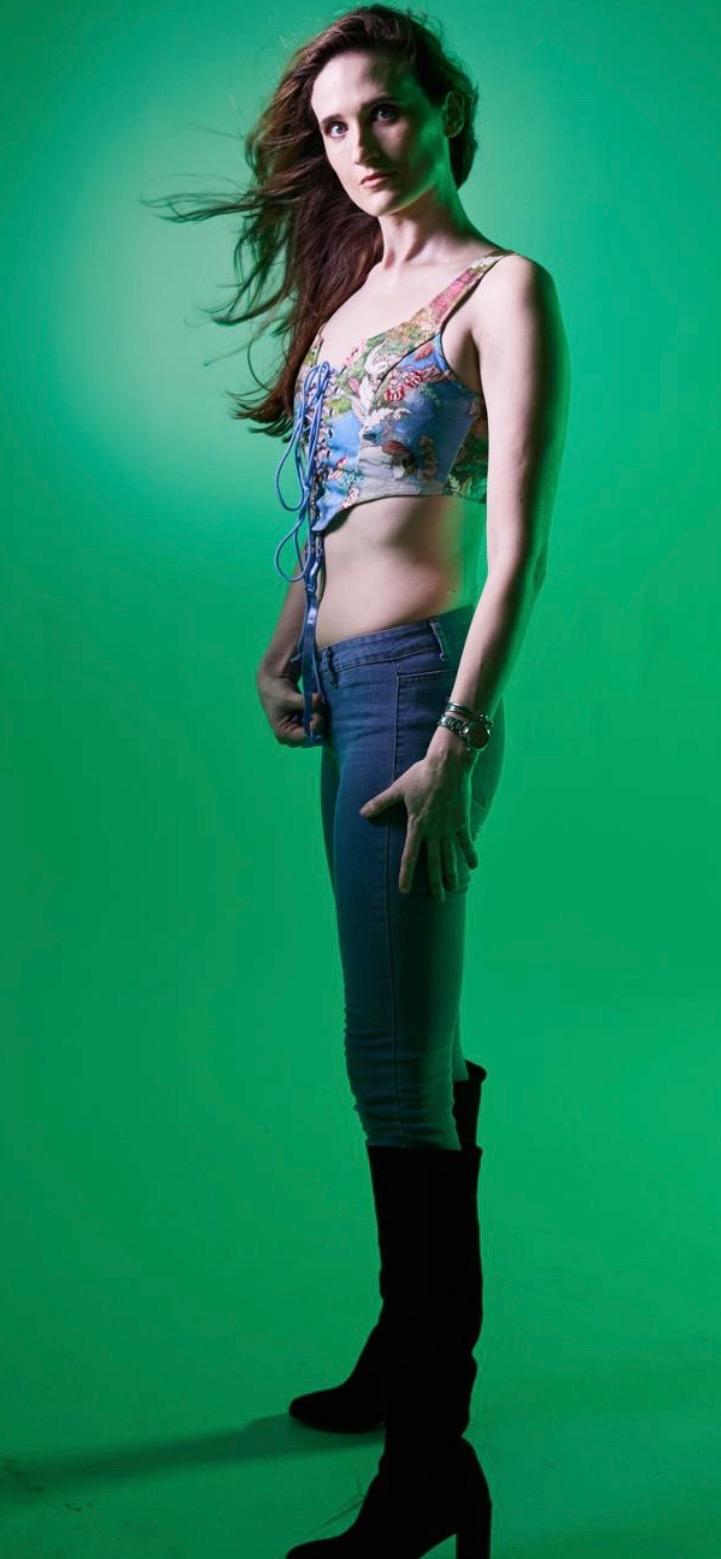
Making this film was a massive comeback for my career goals. I had thought my opportunities in Hollywood were over, since I had not been able to advance my career due to my illness. I proved to myself that I could keep going; I could still work and make art. I even had the chance to model for several brands and companies, which I never thought possible.
My diagnosis with CRPS and the subsequent years of recovery made me believe my life was over. I thought I would never be able to work again and never find love. Who would want a woman with so many physical issues and health problems?
 Like the plots of the movies I adore, I met the love of my life by chance. I had ordered a Lyft to take me to Hollywood for a date. I remember standing in front of my apartment with my crutch. I remember getting in the front seat of his car (this was before the COVID-19 pandemic, and I typically sat in the front seat back then).
We talked about anything and everything. The first thing I remember about him was his voice. His speaking voice still fills my stomach with butterflies. He commands the room without trying. In this case, his voice and temperament put me at ease. This would later become one of the greatest things about our relationship: how easy everything felt with him. Talking with him and being with him has never been difficult or fraught with awkward tension. We connected instantly, and I have never once felt uncomfortable around him.
When we arrived at my destination, he got out of the car to open the door for me. This was the moment I truly saw him. I had not looked at him fully for the entire car ride. I feel awkward facing the driver of any car because I don’t want them to feel they need to meet my gaze for a conversation. Their attention should be on their driving, not our conversation. Plus, we can still talk. But I faced forward for the entire drive.
It was the quality of his voice and the ease of our conversation that left me wanting more. So, when he opened my door, I was dumbstruck. He was so handsome, and my attraction to him was instant. Later on, when I told him this, he laughed and said, “I definitely looked at you before you got in the car and noticed how beautiful you were.”
We dated for several months, but when his grandmother became ill, he moved home to help her. He left on good terms, and over the next four years I compared every guy I dated to him. He returned in 2019, and we have been together ever since.
I truly believe none of this would have happened if I did not have CRPS. If I had been healthy at the time, I would have been at work that day. I would have been driving my own car. But because I couldn’t drive and was working from home, the stars aligned to put us together.
CRPS took so many things from me, but it also gave me things I never expected. I have become mentally and emotionally stronger. I have slowly learned how to exercise my body and how to cope with my pain. I have the support and love of a partner who understands my ailments. He is always there to catch me if I falter.
It has taken 11 years, but I am back in Hollywood. I have been knocked down and devastated so many times, but I have kept going. I refuse to give up, and I have so much to live for. I have a future and a set of goals that make me happy to wake up every day.
The nature of CRPS is pain without a visible injury (at least in my case). I have kept going, and I refuse to give up. Life without pain is not possible, but life without love is unacceptable. Love has been the balm I needed all along. The cure for my overwhelming sadness, anxiety, and agony. I will never fully be without pain, but knowing I have the love and support of my partner makes me eager for the future.